


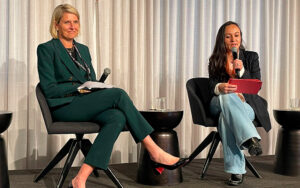
In a lively and inspiring session at HMC, Chrissie Hanson, CEO of OMD USA, sat down with Molly Battin, Senior Vice President and Chief Marketing Officer of The Home Depot, to spotlight a vital shift in how one of America’s most iconic retailers is engaging with the Hispanic community—and reshaping the broader definition of home improvement.
Battin opened with a data point that crystallized the moment: over the past seven years, spending on home improvement by Hispanic consumers has increased by 80%—three times the rate of non-Hispanic households. The market size? An estimated $25–30 billion. And in the next five years, 62% of new homeowners will come from this segment.
This is not a trend. It’s a transformation. One that Battin says is central to The Home Depot’s long-term strategy. “This is a vital audience,” she emphasized. “We’re not just reflecting the community—we’re part of it.”
 What sets the Hispanic customer apart, Battin explained, is a deeper emotional connection to homeownership. “It’s about legacy, pride, and family. For many Hispanic households, the home is the ‘forever home,’ a space for generational gatherings, not just a real estate investment.”
That insight informs everything—from The Home Depot’s Labor Day campaigns to product selection, service, and community programming. “We don’t sell hammers,” she said with a smile. “We sell possibility.”
Hanson steered the conversation to culture—how The Home Depot fosters a mindset of open listening and involvement across its team. Battin credited the brand’s founders and values-driven culture. “We live by the inverted pyramid. The CEO is at the bottom, and our associates and customers are at the top. Our associates are in the communities we serve. They are our best source of insight.”
This mindset extends to how multicultural insights inform general market creative. “More and more, the general market is multicultural,” Battin noted. “We don’t separate those insights—they drive how we tell stories, how we go to market, and how we show up.”
EMPOWERING THE PROS
One of the most powerful segments focused on The Home Depot’s Path to Pro initiative, aimed at addressing the growing skilled labor shortage. With 50% of Home Depot’s revenue coming from professional contractors—many of whom are Hispanic—the initiative is both socially and strategically vital.
Originally set out to educate 20,000 pros, the company has already reached 44,000 and connected over 300,000 individuals to jobs. “We’re investing in the future of work, especially for Hispanic communities, because the opportunity—and the need—is enormous,” said Battin.
Looking ahead, The Home Depot’s sponsorship of the 2026 FIFA World Cup signals a major cultural investment. “Soccer is a passion,” Battin said. “And when the biggest sporting event comes to North America, we knew we had to be on the big stage.”
It’s not their first foray—The Home Depot has sponsored the Mexican national team for two decades and recently supported a charming, soccer-themed campaign with Miguel Layún to promote fast and free delivery. “Awareness of our delivery services was low. Miguel helped us connect in a fun and culturally relevant way.”
To reach the next generation of homeowners—who may be “intimidated” by DIY projects—The Home Depot is betting big on content and influencers. “We’ve just invested in a full production studio,” Battin revealed. “It’s not just about a camera. It’s about creating how-to videos, influencer collaborations, and personalized journeys to help our customers feel confident.”
The goal is to integrate content, commerce, and community—marrying a trusted brand with trusted voices across every channel.
Closing the session, Chrissie asked the question on many minds: How do you make the business case for more investment in multicultural marketing?
“It’s a math story,” Battin answered. “The audience is growing. The spend is growing. The loyalty is strong. But you need the numbers—ROAS (Return On Ad Spend), demand, and lift. Tell the story, show the data, and don’t be afraid to do the math.”
She shared a proud moment from their FIFA pitch: “Our CFO looked at me and said, ‘Molly, if this makes a real difference with the Hispanic audience, I’m in.’ That’s when I knew—we’d broken through.”


