U.S. HISPANIC Versión en español
Content Americas 2026: Realistic Optimism, a More Streamlined and Efficient Market Heading into 2026
Aliana González, Édison Monroy | 29 de enero de 2026
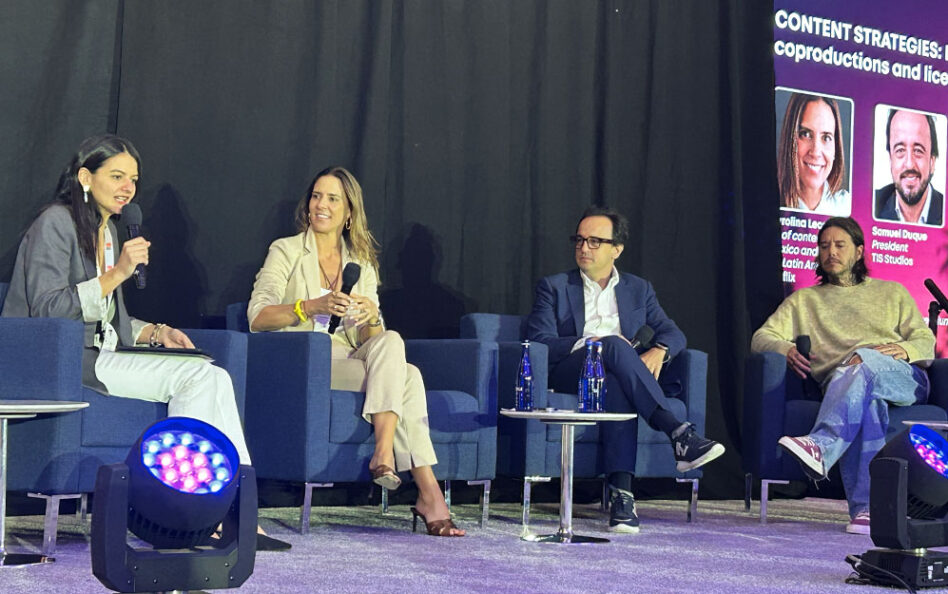
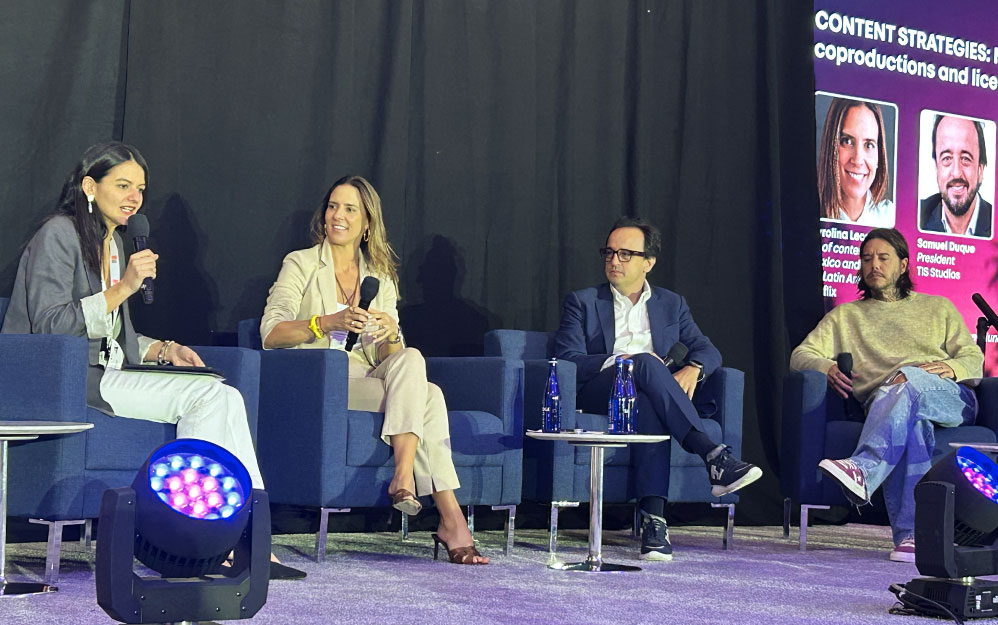
At Content Americas 2026, the conference speakers stood out. Pictured are Carolina Leconte of Netflix, Samuel Duque of TIS, and Sebastián Ortega of Underground
Content Americas 2026 has come to an end—the market that serves as the industry’s gateway to the new year and where the trends that will shape the sector begin to take form. From January 19 to 22, the Hilton Miami Downtown welcomed 2,000 executives, including 150 exhibitors and 450 buyers. In its fourth edition, organized by C21 Media, the event reaffirmed itself as a must-attend date firmly established on the industry calendar.
OPTIMISM WITH FEET ON THE GROUND
The prevailing mood was one of realistic optimism, despite the shared understanding that 2026 will be a transitional year marked by tighter budgets and slower decision-making processes.
According to Pablo Mancuso (Condista), the industry is adapting to a “new reality” in which each player must identify its own opportunities. “It’s different from previous years when we were fighting against changes we couldn’t control,” Mancuso explained, noting that the strong attendance of operators and platforms resulted in a very active business agenda.
Leonardo Zimbrón (3Pas Studios) described Content Americas as the necessary kick-off to take the pulse of 2026. “We have confirmation that buyers are slowing down this year; we’re facing a more sluggish market,” he said. Nevertheless, Zimbrón anticipates acceleration toward 2027, once corporate acquisitions stabilize and post-pandemic saturation fades.
He also highlighted greater openness and transparency from buyers: “We were able to better understand their needs. Streaming platforms now have a more clearly defined identity and have adjusted their content strategies; while deals may take longer to close, there is greater clarity.”
FEWER ATTENDEES, BUT FULL AGENDAS
At the start of the event, organizers reported nearly 2,000 registered attendees. While final figures were not available, a subjective assessment by the PRODU team suggested a slight decrease in overall attendance compared to peak years, but with a stronger presence of decision-makers.
This sense of effectiveness reflects the industry’s current reality: an ongoing consolidation process resulting in leaner yet more efficient teams. Executives arrived with clear roadmaps, facilitating deals and pre-deals that energized the market.
There was also a reduction in the number of suites occupied by distributors, with a total of 35. Since most companies seek prime corner locations with ocean views, organizers placed between two and a maximum of four companies per floor. As a result, hallways were less crowded than usual, and even elevator traffic felt lighter—although elevators continued to present mobility issues. As is customary, there were complaints about wait times or being taken to the wrong floor.
Despite this, 100% of those consulted by PRODU reported having fully booked agendas, with little free time beyond lunch and dinner. The conversations organized by the event were also praised—not so much for the topics themselves, but for the caliber of the speakers.
For many, it is uncommon to hear directly from a Netflix executive such as Carolina Leconte or to cross paths with a director of Juan José Campanella’s stature. Actors were also given a voice. Angelique Boyer participated in one of the panels, emphasizing that a key area of industry growth lies in improving the connection between on-set operational realities and administrative planning.
YOUTUBE AND THE MULTIPLATFORM ECOSYSTEM
YouTube’s relevance was one of the market’s highlights. There is a growing trend of broadcast networks and production companies using the platform as a strategic ally.
“It’s now clear that they don’t compete. On the contrary, YouTube works as an amplification tool, where content can become popular and then successfully cross over to streaming or traditional television,” said María Eugenia Muci of VIP TV 2000.
Although prestige still largely resides in television content—particularly for major streamers such as Netflix, Prime Video, or Disney—players coming from YouTube are no longer viewed dismissively. In fact, many are now selling their content to linear television. A clear example is El Reino Infantil.
Moreover, the widespread adoption of Smart TVs has blurred physical boundaries; for today’s viewers, YouTube is simply another channel on their television set. FAST channels are also continuing to gain momentum, and as in recent years, the opportunity lies with those who can offer clear and reliable monetization models.
VERTICAL CONTENT AND NEW FINANCIAL MODELS
Vertical content has emerged as the most notable and exponential growth format, although effective monetization remains its primary challenge. According to Mancuso, the industry is still trying to understand how to approach this format in a way that generates sustainable revenue.
Still, the future is there, alongside new ways of creating content and engaging with audiences. New players such as Shortmax and Idilio are also entering markets like this one, with representatives in attendance.
They bring fresh ideas, including the view that the vertical microdrama industry is a new and independent space separate from television, requiring different guidelines primarily focused on technology.
In parallel, financing models are evolving: production companies are no longer relying solely on traditional structures, instead arriving with investment funds and financial advisors who package projects for new forms of exploitation.
COLLABORATION AND PARTNERSHIPS
At Content Americas 2026, co-production is emerging as the primary path forward to share risk and expand investment capacity in a market that now more than ever demands collaborative partnerships.
Beyond co-production, a wide range of alliance models are being implemented as solutions to the economic contraction that has characterized the market in recent years.
One example is the creation of ALATV, in which broadcast networks from different countries invest resources to share a single IP. Another, noted by Pablo Mancuso, is the sublicensing of rights, which enables greater efficiency: major rights (such as sports) are being sublicensed across multiple channels and platforms to distribute costs.
Also highlighted were RCN Studios’ announcement of an alliance with 11:11 and W Studios, aimed at boosting production amid a decline in large buyers, as well as 200% Media’s development of a series with CBS Studios, WVE, and Juana Uribe of Caracol Televisión. One of the goals of these collaborations is to retain a larger share of the IP.
KEY TAKEAWAYS FROM CONTENT AMERICAS 2026
Strategic consolidation: Fewer players, but more qualified ones, with greater decision-making power and efficiency-focused agendas.
Vertical content as a testing ground: Consolidated as a space to develop and test IP that can later scale into 360° formats.
Alliances and co-production: In the face of slower platform greenlights, joining forces and sublicensing rights are essential to mitigate risk.
YouTube as a strategic ally: The perception of competition with broadcast TV has faded; it is now integrated as an audience amplification tool.
Looking toward 2027: While 2026 is shaping up as a year of transition and adjustment, full budget and project reactivation is projected for the following year.


Diario de Hoy
|
lunes, 19 de octubre de 2026 |
Noticias relacionadas (8)