
U.S. HISPANIC
Publicitarias Session: Latinas in the Spotlight
2 de julio de 2026
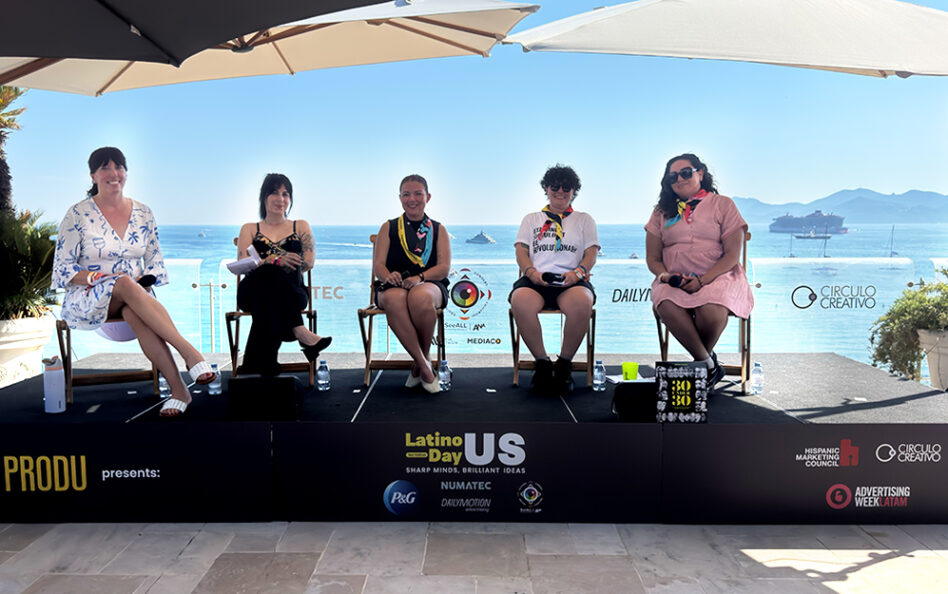
They explore how brands can connect more authentically with diverse audiences, particularly within the Latino community
During the third edition of Latino US Day at Cannes Lions 2026, PRODU invited Publicitarias to lead a conversation on cultural intelligence and diversity in the advertising industry. The organization works to build a more inclusive industry through workshops, tools and resources that help brands, agencies and creative professionals incorporate diversity, equity and inclusion (DEI) into their work.
The session was moderated by Alita Pereyra, Creative & Media Leader and Latino US Day volunteer, who explained that the goal was to explore how brands can connect more authentically with diverse audiences, particularly within the Latino community. She was joined by Laura Rovira, Associate Designer at Monks; Amanda García, Head of Marketing at LicitaLAB; Romina Calcagno, Co-founder of Cosmos; and Karo Gómez, Head of Social Media at Havas HOY.
At the beginning of the discussion, the panelists also expressed solidarity with the people of Venezuela, acknowledging the difficult moment many families and teams are currently experiencing.
One of the panel’s first questions was what cultural intelligence actually means. For Amanda García, it is the ability to understand cultural codes within their proper context. She argued that there is no single Latino consumer or Latino market because Latin America is made up of diverse countries, communities and lived experiences.
“There isn’t one Latino consumer or one Latino market. We’re all Latino, but we’re from Mexico, Chile, Colombia or Guatemala, and we’re different. Even within the same country, we’re very different.”
According to García, the brands that successfully connect with audiences are those that combine data with genuine human understanding and meaningful insights.
Karo Gómez added that brands need to do more than analyze data—they need to “feel the vibe” of culture. Drawing on her experience in social media, she warned that advertisers often rush to join trends without asking whether a brand truly belongs in the conversation.
“We want to join trends and conversations, but not every conversation needs a brand or a logo beside it. It’s important to understand where culture comes from and how to approach it honestly.”
She cited Cinco de Mayo as an example. While many U.S. brands use the holiday to represent Mexican culture, Gómez noted that it does not hold the same cultural significance within Mexico itself.
“In Mexico, we don’t celebrate Cinco de Mayo the way it’s celebrated elsewhere. There aren’t piñatas, burritos or tacos because of that holiday. Brands can absolutely talk about Mexico—but they need better context and a different point of view.”
From a design perspective, Laura Rovira emphasized that diversity is not only a value but also a creative advantage. She argued that bringing multiple perspectives into creative teams helps uncover blind spots and produce work that better reflects people’s realities.
“Diversity helps us discover blind spots and create more relevant experiences. It’s not enough to target audiences—brands need to truly understand them.”
For Rovira, inclusion must be embedded throughout the creative process rather than treated as a final layer of validation.
The discussion also explored authenticity as a business driver. Amanda García explained that, in growth marketing, authenticity should be viewed not as a desirable quality but as a business metric.
When campaigns feel genuine, she said, organic engagement increases, customer acquisition costs decrease and the entire marketing funnel performs better.
“Authenticity in growth marketing isn’t a nice-to-have—it’s a business metric. When consumers trust you, that trust drives the entire funnel.”
Drawing from her entrepreneurial experience and her work with global brands such as BYD, Romina Calcagno discussed the importance of localizing brands without losing cultural sensitivity.
She explained that when a Chinese brand enters a market like Uruguay, consumers need to see themselves reflected in the advertising.
“It’s a Chinese brand that’s culturally very distant from us. That’s why we need to place the car on our streets, with our people and our daily habits—drinking mate or spending time along the waterfront. Representation matters.”
Artificial intelligence also became part of the conversation. García argued that AI will not replace creative teams but instead help them think more strategically while streamlining workflows. Human judgment, however, remains essential when deciding whether an idea truly fits a specific market.
“AI helps build things and improve efficiency, but humor, understanding and the human touch belong to people. People are the ones who can say, ‘This won’t work in my market.'” Reflecting on leadership, Rovira said her role extends beyond managing teams or designing campaigns.
“As a leader and as a Latina, I’ve learned that different perspectives add value to every team. Part of my role is creating spaces where those ideas can exist, be heard and be challenged.”
Toward the end of the session, the panelists offered advice to young women beginning their careers. Amanda García encouraged them to “bring your own chair” if there isn’t a seat at the table—and then help other women build theirs. Calcagno added that if a table isn’t the right fit, creating a new one or finding another community is equally valid. Karo Gómez expanded on that idea by challenging traditional definitions of success.
“Before trying to sit at someone else’s table, ask yourself what your own table looks like. Maybe it’s not a table at all—maybe it’s a dance floor or something completely different that makes you happy. My real advice is: be happy.”
Asked to summarize the superpower of Latinas in one word, the panelists chose empathy, pragmatism, courage and “salsa”—meaning flavor, energy and authenticity.
“We bring flavor to everything we do, and that’s what I love about Latinas.”
The session concluded with a clear takeaway: cultural intelligence is not a passing trend but a strategic capability for brands seeking authentic connections with Latino audiences. In an industry increasingly shaped by AI, automation and the speed of digital conversations, the panelists agreed that the true competitive advantage lies in understanding context, avoiding stereotypes and never losing the human perspective.


Diario de Hoy
|
jueves, 2 de julio de 2026 |