
U.S. HISPANIC Versión en español
Director Pipe Ybarra: “Among The Keys To The Success Of Hasta Que Amanezca Are Its Very Grounded Characters”
Maribel Ramos-Weiner | 24 de abril de 2026
Director Luis Felipe "Pipe" Ybarra Becker noted that, except for the cinematographer, the assistant director, and himself, the entire technical crew was Colombian
Among the keys to the success of the film Hasta Que Amanezca (90’), a Sony Pictures Television production that debuted on HBO Max in Latin America at the beginning of this month and benefited from the Audiovisual Investment Certificate (CINA) from Proimágenes Colombia, are its characters, according to its director Luis Felipe Ybarra Becker.
“We have very well-acted, very grounded characters that audiences can identify with. It’s a very female-driven film: it’s about four friends. I surrounded myself with women to make it, and I also have that sensitivity because I live surrounded by women at home,” Ybarra told PRODU.
MEXICO CITY’S ARCHITECTURE VERY DIFFERENT FROM BOGOTÁ’S
Ybarra said one of the main challenges was making audiences believe the film was shot in Mexico when it was actually filmed in Bogotá.
“The story is very easy to grasp. It’s about a betrayal and then a recovery, but the script was already written with closed locations in mind, and it takes place at night—‘at night, all cats are gray’—so that helped us to be out on the streets. But Bogotá has a very distinctive architecture, very different from my Mexico City. That was the first big challenge,” he explained.
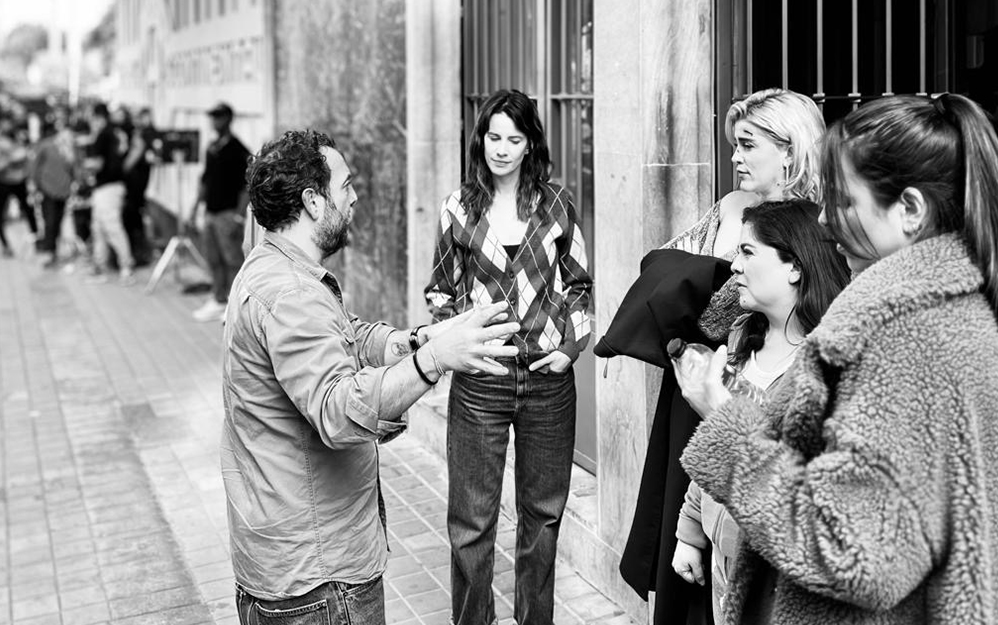
Ybarra interacts with the cast during the shooting of Hasta Que Amanezca
He added that by working with the team, “which was incredible and very professional,” he was able to get help finding locations such as the nightclub referred to as El Bull. “El Bull was a ’90s nightclub. We found El Teatrón, which was a huge venue that told a story. That was the biggest challenge: shifting my mindset and the team’s to make it feel like Mexico. I’ve always said that in the end, no one will question whether it’s Mexico or Bogotá. For me, it’s Gotham City—but no one will question it. And it doesn’t matter—it works very well,” he said.
THE TAX INCENTIVE OPENED UP MORE RESOURCES
Although Ybarra admitted he doesn’t know all the technical details of the CINA incentive the production received, for him the most important thing was “being able to tell the story, to make a film, and also that it helps generate industry for local crews.”
He emphasized that the State reimbursing that money can also be reflected “in how your budget allows you to access other types of resources. For example, we shot on the streets with eight cameras, and those kinds of things matter for us on set.”
ENTIRELY COLOMBIAN CREW
Ybarra noted that, except for the cinematographer, the assistant director, and himself, the entire technical crew was Colombian. “I’m talking about focus pullers, electricians, wardrobe, art, makeup, the gaffer. The three of us were the only ones who traveled from Mexico, along with the actresses, of course,” he said.
STREAMING PLATFORM OR MOVIE THEATER
Asked whether the approach changes when making a film for streaming versus theaters, Ybarra said it does. “It changes in a technical sense. A platform usually asks for a different framing and aspect ratio than a theatrical release. From there, the visual language shifts slightly in how you shoot it. It’s a different rhythm, although the same rigor and preparation apply, whether it’s for cinema or a platform,” he said.
The director shared that he lived in Colombia for three months during filming. “I’m 49 years old, already a creature of habit, and I lived away from home missing my daughters, my wife, and my dogs. Now that I watch the film a year later on streaming, as a viewer, it gives me tremendous nostalgia. The film left me with a very beautiful story that I hope connects with audiences. It also gave me great friendships—a family. It gave me the opportunity to work with extraordinary actresses—Luz Aldán, Giovanna Romo, Laura Londoño, and Cassandra Sánchez Navarro—and to give an opportunity to someone who needed it and who is an extraordinary actor: Andrés Borda. I also worked with one of my best friends and directors I respect most, Martín Altomaro, and with my great friend and ‘little brother’ Daniel Tovar. It left me eager to return to Colombia to keep telling stories. It’s been a very exciting journey,” he said.
Pre-production for the film took about six weeks, with five weeks of shooting. Post-production lasted 10 weeks.
THANKS TO CARLOS QUINTANILLA
Finally, he thanked Carlos Quintanilla, the film’s creative director and VP & Head of Content and Production for SPT Latin America and U.S. Hispanic, “because he was the one who brought me in to tell this story, who trusted me. I want to thank him because he put me in a position where I had to step out of my comfort zone—it was a story about women told by a man. In today’s world, where everything is polarized and labeled, we decided to take the risk, and in the end, with all the love and respect in the world, we achieved a film carried by its actresses and actors. It’s a cast I’ll keep in my heart for the rest of my life.”


Diario de Hoy
|
viernes, 23 de octubre de 2026 |
Noticias relacionadas (4)

30 de octubre de 2025
La película Hasta que amanezca de SPT recibió incentivos de Proimágenes Colombia

