U.S. HISPANIC
When a Lion Became a Microphone: Sebastián Arrechedera on How Venezuela Came Together in Cannes
21 de agosto de 2026
Chronicle of a week in which Venezuela won, shook, and came together in Cannes.
Chronicle of a week in which Venezuela won, shook, and came together in Cannes.
By Sebastián “Pana” Arrechedera
TUESDAY, JUNE 23
María Corina Machado, the Nobel Peace Prize laureate, is waiting on a video call screen. The Titanium jury is there too. Chaka Sobhani, TBWA’s Global Chief Creative Officer, who chairs the jury, Andrea Diquez from GUT, Cindy Gallop, and seven other jurors who have shaped global creativity over the past decade, all waiting. And I am running, lost through the corridors of the Palais des Festivals, panting, unable to find the room.
To explain how I got there, I have to go back a few hours, to when I received the news.
The morning starts very well. I finish recording an episode of El Martínez podcast bar, with Beto Nahmad, a great Argentine creative living in Spain who reminds me what it means to start from scratch as a migrant.
I leave that sensitive conversation moved, and sit down in a chair at the 72 Croisette to check my email because I am waiting for news. And there it is: we won two Gold Lions with 600K Network. The first two Gold Lions for Venezuela in the history of Cannes Lions.
I start crying in front of the team that is still recording.
I cry for the political prisoners, for those who have been tortured, for the injustices I have had to hear about over two years of interviewing the people who made this case possible. Like Yesenia, the midwife who ended up hiding with her two children, pursued by intelligence agents simply for defending the vote, eating fruit from trees to survive. Or Luis, who was imprisoned in Tocorón, where they took him to be tortured in Adolfo’s bed, a box with a steel door. Luis now lives in Spain, where he continues to tell the story of what he went through. All of this comes rushing through my head with an email whose subject line is purely administrative.
And that same afternoon, with my heart racing, I am going to have to present the case to the Titanium jury.
If I can find the room.
Later, I am sitting in the press room, rereading for the umpteenth time the two pages of my presentation, when my phone vibrates. A new contact. Three letters: MCM. And a five-word message: “Hi Sebastián, it’s María Corina.”
I reply immediately, butterflies in my stomach. I ask her how she would like to handle the meeting. I suggest that she lead the jury’s questions and answers, and tell her to give me the floor if at any point she would prefer me to answer. She sends me a voice message in which I hear her say “of course,” “whatever you think,” and ask who she should address.
A woman who confronted a regime with nothing but the power of her ideas, who one day emerged from hiding in Venezuela on a boat to Curaçao, heading to Oslo, to travel around the world carrying the truth of all the people who support her to the most important leaders on the planet, asking me humbly about the protocol in that warm, close way she has of speaking.
Minutes later, the technical disaster arrives.
I connect to Teams from a small press room at the Palais. María Corina is there on time, as is the entire jury. I say the first lines I have rehearsed for days, and they stop me. The jury cannot hear me at all. The internet connection cuts out.
I try to explain that the Wi-Fi is not working, and that is when I hear Chaka Sobhani’s voice: “Love, are you in the Palais? Come here.”
I run off to find the room. Behind me, the podcast recording crew that has spent the entire week filming episodes with festival jurors, unaware that they are about to document this. When someone finally shouts my name and I reach the room, we rush in together: an invasion of Venezuelans bursting into the room of the most demanding jury at Cannes.
Cannes Lions staff stop us, and my team is left outside.
I go in alone, panting and sweating. Pancho Cassis gives me a glass of water and tells me to relax, that everything is fine. Chaka resets the presentation clock so I can breathe and start from scratch.
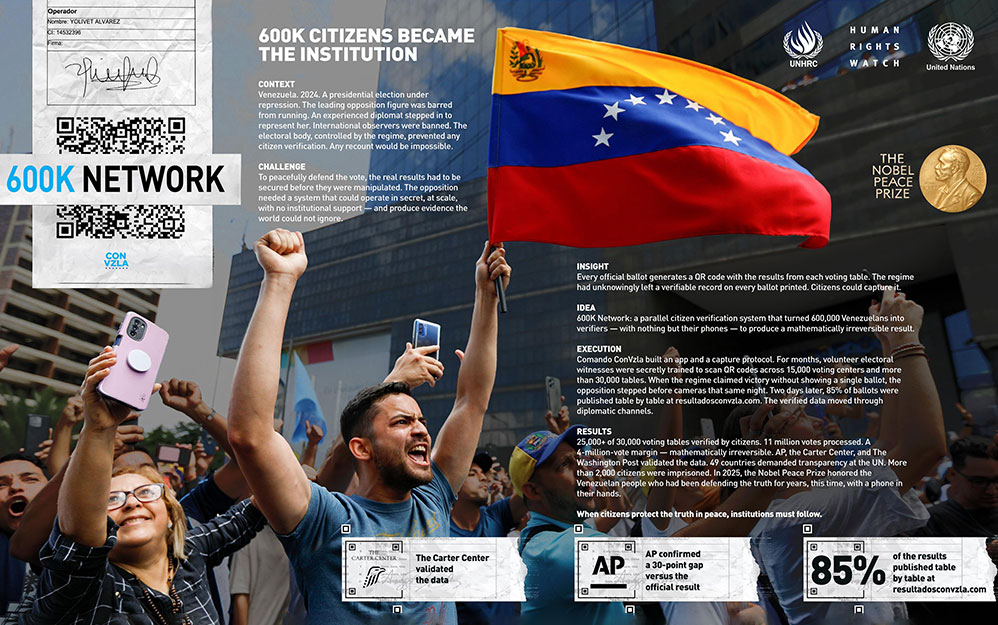
And then what had to happen happens: María Corina tells that jury, publicly for the first time, what her sixteen months in hiding were like. How she learned they were coming for her. The safe houses. The persecution. A Nobel Peace Prize laureate explaining how Comando Con Venezuela and 600,000 citizens built a parallel citizen election-verification system that left a regime without a narrative.
WEDNESDAY, JUNE 24
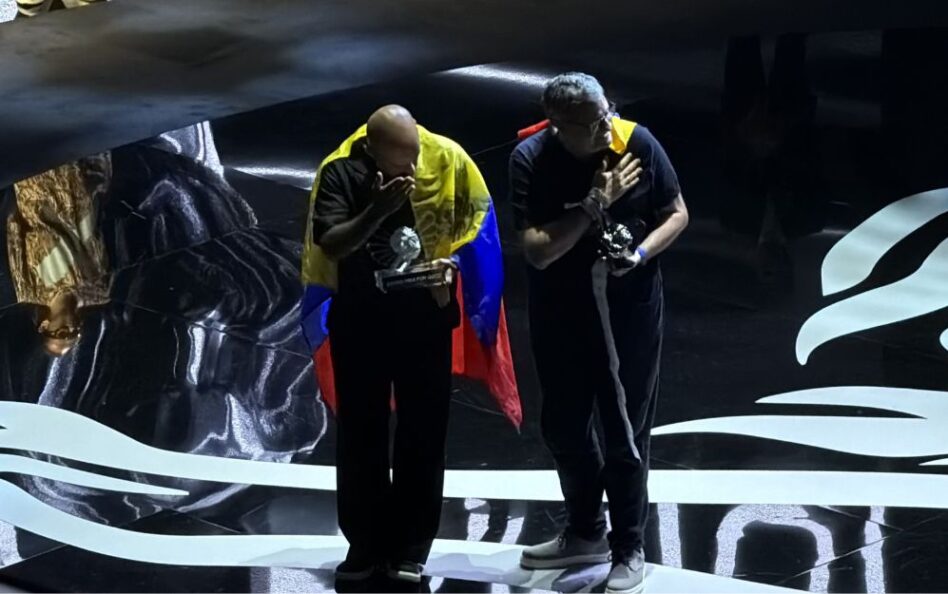
It is the night of the Gold Lion awards at the Lumière. We meet with someone from the Cannes Lions organization because they knew there were anonymous people listed on the entry form and wanted to know whether anyone was planning to go on stage wearing masks. At first, we thought they wanted to prevent the gesture. It was the opposite: they wanted to be able to explain it from the stage if it happened. But we had already found a better way. The Venezuelan flag would cover the faces of those who could not show themselves, because the regime that persecuted those who scanned a QR code remains in power and continues to hold political prisoners.
That night, all the Venezuelans who were in Cannes went up to receive the Gold Lions, which belong to everyone. Within a minute, the stage became a carnival of flags in a theater that is not accustomed to a standing ovation on a Wednesday night.
Two hours later, we are outside the Hôtel Martinez, where everyone gathers when night falls, celebrating with friends one only sees once a year. Marly, my wife, comes up to me and says a sentence I still haven’t fully processed: “Don’t worry, your dad is okay. There has just been an earthquake in Venezuela.”
My other homeland is Mexico, and earthquakes happen there; I am used to receiving news about tremors. But I never imagined what was actually happening. I open social media and understand. A seismic doublet, something seismologists consider extremely rare: a magnitude 7.2 earthquake in the north of the country followed seconds later by another measuring 7.5. Collapsed buildings. Tens of thousands of people under the rubble. I try to call my dad, but the call won’t go through. All around me, the Cannes party continues to roar.
THURSDAY, JUNE 25
The same Venezuelans who had created the carnival of flags get together to think. The Círculo Creativo de Venezuela and the Círculo Creativo de Estados Unidos were there, joining forces to help. There was only one question: how could we take advantage of the fact that we were at the media epicenter of the industry, with a story everyone was talking about, to help our country in the middle of an emergency?
The answer was a QR code. This story had begun with a QR code printed by the regime on every electoral tally sheet, which 600,000 Venezuelans photographed to document the truth of an election. And now, in Cannes, we were printing another QR code, this time our own, to raise aid for the victims of the earthquake. We placed it at different points throughout the festival and asked Cannes to issue a call to action through its own platforms. The same gesture that in Venezuela was grounds for imprisonment—scanning a code—was now a way to help the country from the other side of the Atlantic.
FRIDAY, JUNE 26
I find out through another email that we have won the Titanium, the festival’s most demanding award, and the Grand Prix for Good, given to the best work among all the work that does good. Two things happen to me at once: the excitement of knowing that we are achieving the goal of making the world aware of the truth through these awards, and the anguish of thinking about all the people suffering in my country.
Then a message arrives from a new great friend, Jimmie Stone, Meta’s VP and a Venezuelan, one of so many members of the diaspora who have gone out into the world and made their mark. He shares his view of what he thinks should happen on closing night, and it makes perfect sense to me: move from the carnival of celebration to mourning. Walk onto the stage solemnly, wrapped in the flag. I go buy black clothes to be worthy of the honor of representing my country at such a delicate moment.
The closing ceremony was the exact opposite of Wednesday’s. I walk onto the Lumière stage with Alberto Chumaceiro, who had obtained and brought an original electoral tally sheet from July 28, the same one the jury had physically held in their hands while evaluating the case. Carrying one of those tally sheets is no small gesture: in Venezuela, possessing one was enough to land you in prison. We walk onto the stage with the Venezuelan flag on our backs, in mourning, without celebrating. The same stage where 48 hours earlier we had created a festival of flags now held a moment of remembrance for those killed in the earthquake, and a plea to the entire industry, delivered by Juan Señor: Venezuela needs you now.
That is when I understood what an award is for. There is a moment when a Lion stops being an object and becomes a microphone. We brought 600K Network to Cannes to honor 600,000 people who risked their freedom to defend a vote, and to tell a story the world did not know. The earthquake forced us to use that microphone for something even more urgent. In the end, the two things became one and the same: putting Venezuela at the center of global attention at the moment it needed it most.
I got to experience the unity of a country in one week. First, Venezuelan creatives coming together to tell the truth about an election. Then, those same people, in that same week, coming together to respond to a tragedy.
The next day, my dad finally answered the phone. He was okay. Millions of Venezuelan families made that same call that night, and not all of them received the same answer. For them, we continue to tell this story. The award has already been given. The election remains stolen. And until that changes, telling the truth remains the only job.
This story in Cannes is not mine. It was made by many Venezuelans scattered around the world: Matilde Neuman, who lived every minute of this case from Brazil without being able to be at the Palais; the Fénix Media team; Verónica Ruiz del Vizo, Prakriti Maduro, and Marcel Rasquin, who helped get María Corina in front of that jury; Virgilio Flores and Javier Osorio, who organized the brainstorm at the Produ house; and, of course, Comando Con Venezuela, the entire team that conceived and built what we translated, led by Magalli Meda, Gabo Bracho, and Claudia Macero.
There are also those who covered their faces with the flag, those I cannot name because the regime is still there. They know who they are.

Etiquetas

Contactos

Empresas


Diario de Hoy
|
miércoles, 18 de noviembre de 2026 |
Noticias relacionadas (1)
29 de mayo de 2026
Venezuelan Citizens Turn QR Codes Into Evidence in Cannes Lions 2026 Case